 (833) 227-6773
  info@acpmp.org
  751 Sproul Road #1057, Springfield, PA 19064
 ACPMP is excited to announce the creation of the ACPMP Appendix Cancer Pseudomyxoma Peritonei Patient Registry, a collaborative effort between ACPMP Research Foundation and the National Organization for Rare Disorders (NORD) to study Appendix Cancer and Pseudomyxoma Peritonei.
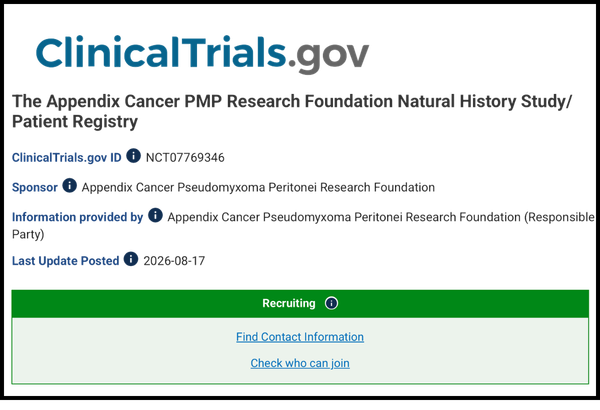 The ACPMP Research Foundation Appendix Cancer/PMP Patient Registry and Natural History Study is a patient-powered global research initiative created in collaboration with the National Organization for Rare Disorders (NORD).
More than a database or a collection of surveys, the Registry is designed to collect high-quality, longitudinal data from patients and caregivers around the world to help researchers better understand appendix cancer and Pseudomyxoma Peritonei (PMP), support clinical trials, and drive breakthroughs in diagnosis and treatment.
A Research-Ready Global Resource
The ACPMP Patient Registry was built with the infrastructure and oversight needed to create a meaningful, lasting research resource for the appendix cancer and PMP community.
The Registry operates under active, ongoing Institutional Review Board (IRB) oversight, helping ensure that participant rights, privacy, data security, and ethical research practices remain central throughout the life of the study.
It is powered by NORD's IAMRARE® platform, an industry-leading rare disease research platform built to be consistent with the FDA's current thinking on natural history studies.
How Your Participation Advances Research
Participants provide information and their clinical data through secure electronic surveys about their diagnosis, treatment, disease progression, outcomes, surveillance, and quality of life. As part of this registry, participants upload their own pathology reports, genomic sequencing and ctDNA reports, and other clinical information. This data is added to a global database that helps researchers identify potential targetable mutations and accelerate the development of new treatments for appendix cancer worldwide.
By collecting and storing all of this information in one global data bank, the Registry will help researchers worldwide to:
- Better understand appendix cancer and PMP and how they progress
- Identify patterns in diagnosis, treatments, tumor characteristics, and outcomes
- Support the development of new diagnostics and treatments
- Inform future clinical trials and research initiatives
All information is securely managed through NORD's IAMRARE® platform, and data shared with researchers is de-identified to protect participant privacy.
Your Participation Helps Move Research Forward
Every participant adds valuable information to a growing global research resource dedicated specifically to appendix cancer and PMP.
Whether you are newly diagnosed, currently in treatment, a long-term survivor, or participating on behalf of a loved one, your experience can contribute to a deeper understanding of these rare diseases and help build the foundation for future research.
Participation is free and voluntary, and the Registry can be completed at your own pace. Participants may withdraw at any time.
Join the ACPMP Patient Registry and help build the data that can drive the next generation of appendix cancer and PMP research.
Frequently Asked Questions
What is the purpose of the ACPMP Research Foundation Appendix Cancer/PMP Patient Registry?
The primary aim of the ACPMP Research Foundation Appendix Cancer/PMP Patient Registry is to conduct a prospectively planned and efficient natural history study that will lead to a better understanding of the disease and its course and pace over time. Other registry objectives include the following:
- To provide a convenient online platform for participants (or caregivers) to self-report cases of Appendix Cancer and/or Pseudomyxoma Peritonei (AC/PMP).
- To develop a contact registry within the ACPMP Patient Registry (e.g., to notify participants of research studies and clinical trials).
- To characterize and describe the population affected by AC/PMP as a whole, enhancing the understanding of disease prevalence, phenotype, and the rate of progression of signs and symptoms over time.
- To help the AC/PMP community develop recommendations and standards of care.
- To be a case-finding resource for researchers either retrospectively studying the pathophysiology of AC/PMP or intervention outcomes or designing prospective trials of novel treatments.
How are the data collected?
Data are collected through a secure web-based application (that can be accessed by computer, tablet or phone) developed by the National Organization for Rare Disorders, Inc. (NORD®), (learn more about NORD below). Study participants respond to questions grouped within a series of surveys developed per study standards and in collaboration with disease specific experts.
What types of data will be collected in the ACPMP Research Foundation Appendix Cancer/PMP Patient Registry?
The data collected includes but is not limited to:
- Socio-demographics
- Medical and diagnostics
- Treatment and disease progression
- Management of care
- Quality of life
Who is a Study Participant?
A Study Participant is the individual about whom information is entered into the registry. In the case of an independent person of legal age, this individual will consent for and enter information about themself. If an individual is not of legal age or is an adult who requires someone to act on their behalf, a person (Caregiver/LAR, see below) who is legally responsible for their health care will provide consent and enter information about the Study Participant.
What is a Legally Authorized Representative (LAR)?
An LAR is someone who is authorized under applicable law to consent and enter data in the registry on behalf of another individual. The LAR may be a parent, grandparent, spouse, caregiver, or guardian as long as they have the legal authority to grant consent on behalf of that individual. An LAR will sign up on the IAMRARE platform with a Caregiver account. When an LAR acts on behalf of a study participant, they are considered to be the reporter in the research.
What is a Designated Representative?
A Designated Representative is a legal adult who was the caretaker of an individual who passed away from Appendix Cancer. This may be a spouse, parent, sibling, offspring, close relative, close friend, guardian and/or significant other of this individual. This person must have had knowledge of and participated in the medical care of the deceased. These individuals are permitted to enter retrospective data on their behalf.
After consenting, can a Participant choose to stop participating in the study?
Participants are able to withdraw from the study at any time. However, researchers may still use the information that they have collected prior to the participant changing their mind. Information that has already been shared with researchers prior to withdrawal cannot be retrieved or removed.
Is the data safe?
The registry follows strict government guidelines to assure patient information is protected. The platform is served over HTTPS, which means that the data is encrypted when being sent from the user’s browser to the NORD servers. The data is also kept encrypted in the NORD database. Communications between the registry platform application server and the database are also encrypted. As with any information you provide electronically, there is a very rare chance that your privacy could be compromised. However, the registry and the security measures minimize the chance of this occurring.
Who will have access to Protected Health Information (PHI)?
All data, including those with PHI, will be stored in a password protected secure server. Access to PHI will be limited to:
- Approved members of the ACPMP Research Foundation Appendix Cancer/PMP Patient Registry research team
- NORD staff, in cases where technical support is needed and with the permission of registry staff
- With agreement from the Sponsor, NORD may conduct IRB-approved, cross-disease research using registry data.
In all cases, your privacy will be protected. The Registry Advisory Board will evaluate all requests for data from researchers. Researchers will only be provided with the minimum data necessary to accomplish their research study goals. Data containing PHI will only be shared if the research cannot be done without it. The researchers will be required to sign a Confidentiality Agreement in which they promise to keep your information safe.
How is the registry maintained?
The registry is maintained by NORD who hosts the registry on its web-based application. NORD provides ongoing technical support of the system. Appendix Cancer Pseudomyxoma Peritonei Research Foundation provides the day-to-day management of their patient registry.
Click here for the full list of Frequently Asked Questions.
To learn more and participate, please visit: acpmpregistry.iamrare.org
Please contact patientregistry@acpmp.org with any questions.
Dr. Erin P. Ward, MD
Chief Medical Advisor
ACPMP Research Foundation Appendix Cancer/PMP Patient Registry
Surgical Oncology, University of Utah Huntsman Cancer Institute
Deborah Shelton
Principal Investigator
ACPMP Research Foundation Appendix Cancer/PMP Patient Registry
Executive Director, ACPMP Research Foundation
Margaret Najarian
Patient Registry Coordinator
ACPMP Research Foundation Appendix Cancer/PMP Patient Registry
Operations-Development Assistant, ACPMP Research Foundation